Art School Portfolio Two 1983-1997
A Moment in Time
Hover to find linked images.
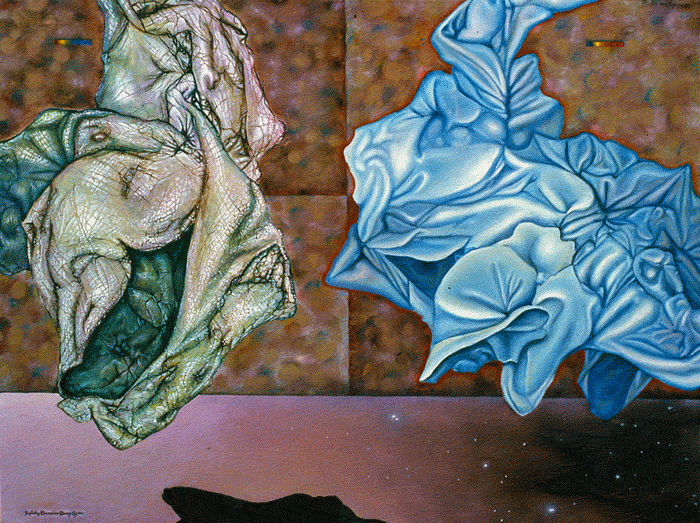
Imploding Kleenex (1983)
Oil, acrylic, acrylic gel, and metallic paint were used in the production of this canvas.
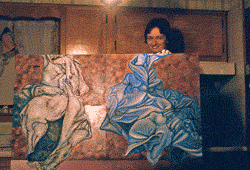
I painted more at my mother’s kitchen table than in the studio space given me by the university. I was a fiercely private person who did not relish the judgment of prying eyes.
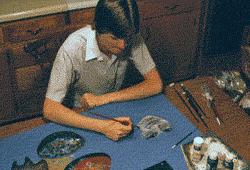
artist and effort
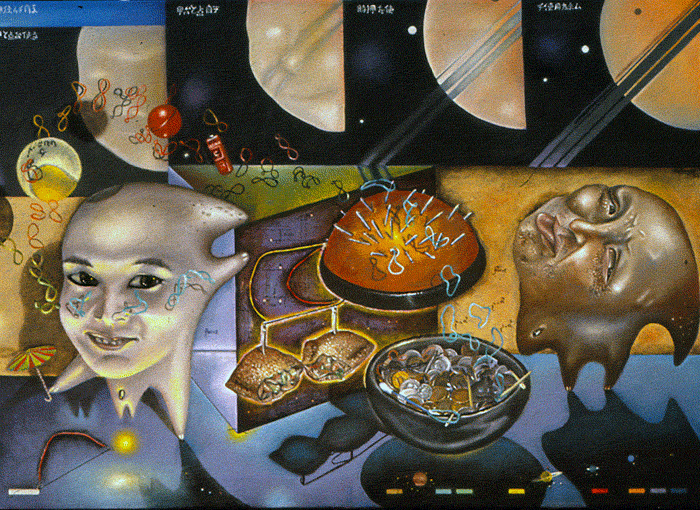
Doppler Shifts (1983)
The title of this painting had something to do with Doppler Shifts. I was taking astronomy classes, which Imploding Kleenex and this painting reflect. There was also the influence of the Voyager space probes, so images of Saturn and Jupiter are scattered in the backgrounds of both paintings.
Modernist Inspired
An Upstart From The Get-go: Once I had impressed my teachers at Memphis State University (now The University of Memphis) that I could paint a conventional still-life, I set about never painting a work of conventional realism again.
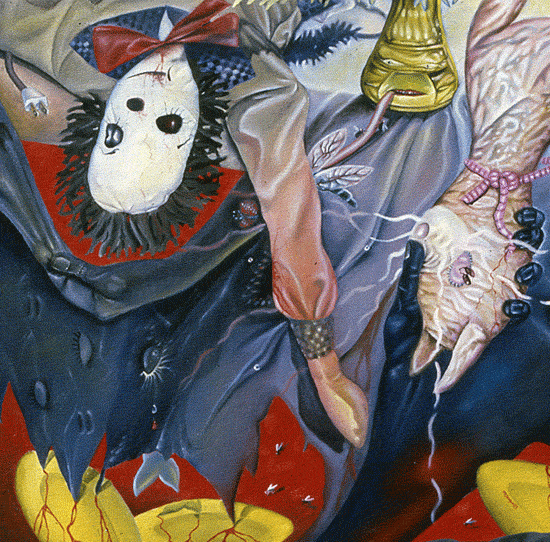
Tabling Halloween Pangs (1983)
This is one of a handful of canvases painted on college premises. This venture began its life with a still-life set up in a painting class. Still-lifes would play a major role in how I generated ideas for paintings over the next two decades.
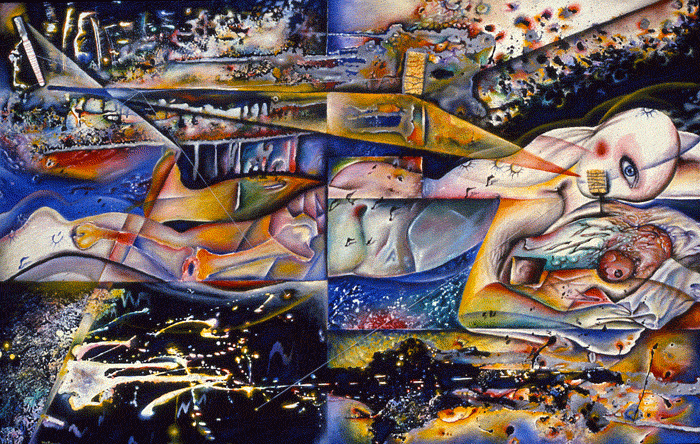
Nuclear Hygiene (1983)
I combined oil, acrylic, cloth sculpture, and found objects in this Pollackesque painting. (If you look carefully, you may spot a used toothbrush.) This work was inspired by Dali’s psychedelic painting Tuna Catch.
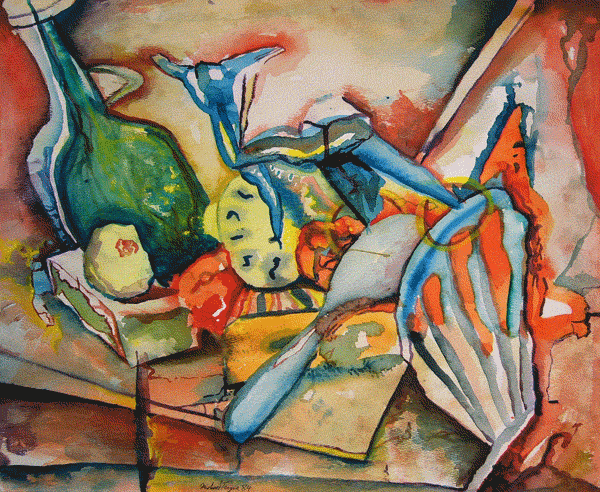
Untitled Watercolor (1983)
This was a watercolor based on another still-life. It was inspired by Bauhaus artists Kandinsky and Klee, as were other watercolors I made at this time.
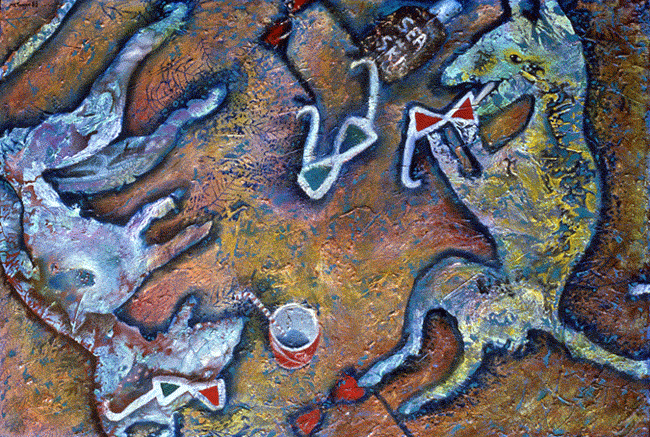
Lab Animals on Vacation (1983)
Klee and Dubuffet are my inspirations here. This work resembles an encaustic painting, and was created by applying wax and oil over a textured surface of acrylic and modeling paste.
Cloth Sculpture Paintings
I made a number of painting-sculptures, often decorated with acrylic and enamel paint. One, featuring a photo-realist badminton racket with a sliced shuttlecock added to it, slipped through my net without me obtaining a decent slide of it. I sold that painting—which is always a rare accomplishment.
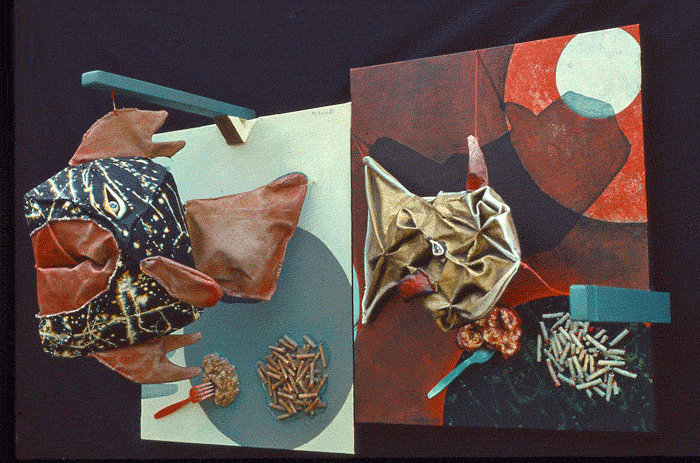
Non-Confroming Main Course (1983)
Another mixed media painting from a busy year. This is cloth sculpture (a la Oldenburg) with modified found objects (a la Synthetic Cubism). Synthetic Cubism introduced collage elements to painting, and it was one of many techniques I incorporated.
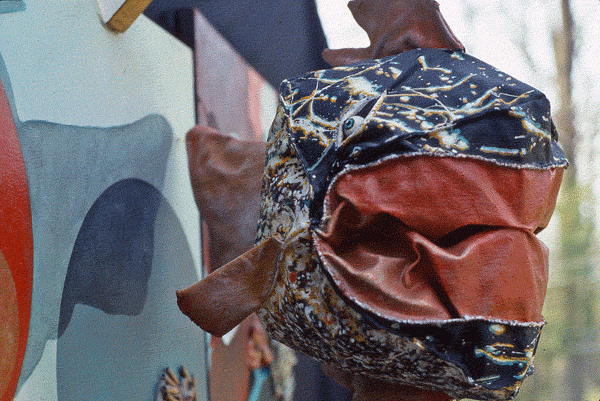
Non-Confroming Main Course (detail)
Left to My Own Devices: The nature of art schools lead many to believe that they are closed-minded societies. My art professors had their tastes, and spoke disparagingly of certain famous artists, but you could take or leave their opinions. Memphis State University was a commuter college that, coming at the end of the Modernist era, was pre post-ism; and consequently I was left to pursue my own interests. It was not until I entered graduate school that I encounter a school of thought and its disciples.
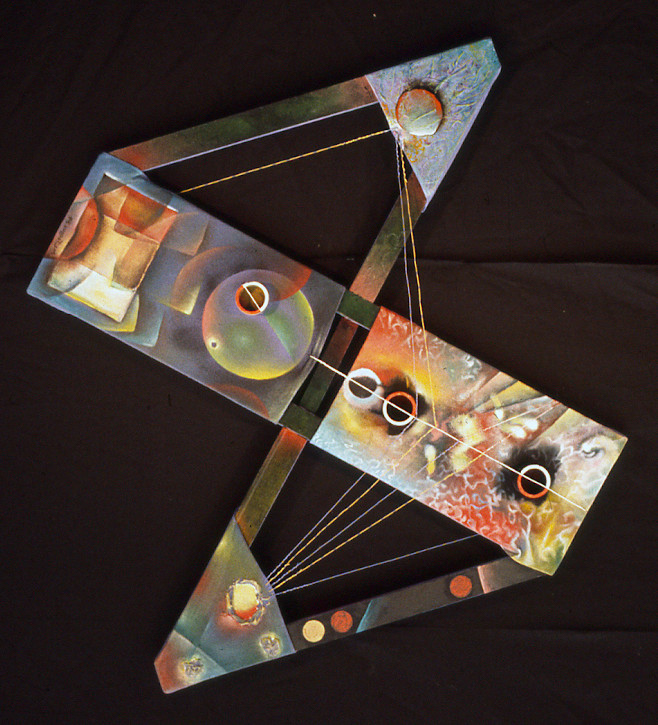
X Painting (1984)
This painting is sculptural in a different sense. Another painting along these lines featured a cloth Wrigley Spearmint Gum wrapper. However, X Painting photographed better, so made for a better slide.
A few of these abstract experiments included materials being applied to their surfaces, such as aluminum foil, bubble wrap, and silicon caulking. (Silicon was used here.) I even created one painting using illustration board set in a wood frame so I could place a spinning motor in it. That painting similarly failed to create a good slide.
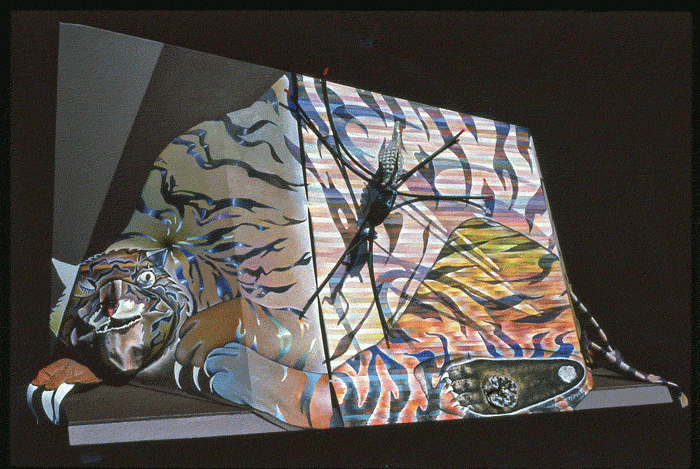
Telegraphing One’s Intentions (1984)
More oil, acrylic, cloth sculpture and modified found objects. Professor Larry Edwards told me in a critique that I used the color red violet too frequently. On realizing this, I have used the color sparingly since.
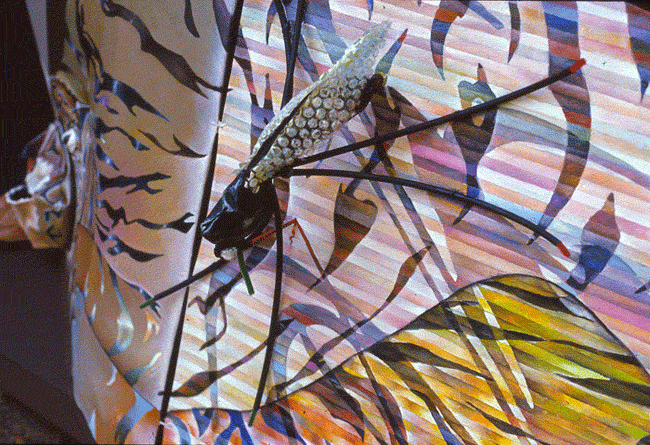
Telegraphing One’s Intentions (detail)
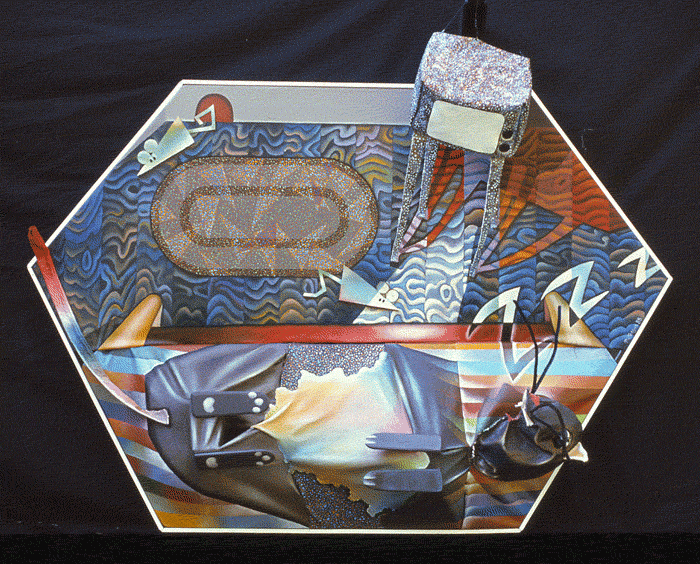
His Vigil Having Lapsed (1984)
Figurative Hybrids and Noteable Class Projects
Snares of The Self-Taught Painter: My main regret as an artist is that, because of my insistence on imagination, I did not allow myself to be influenced by representational artists, especially as representational painting was (generally) what I did. Resultantly, I was unable to apply gained know-how in this area retroactively on so much unschooled early work. I do not shrink from sharing this work with you, since my mistakes, and lessons learned, have benefited my painting students greatly.
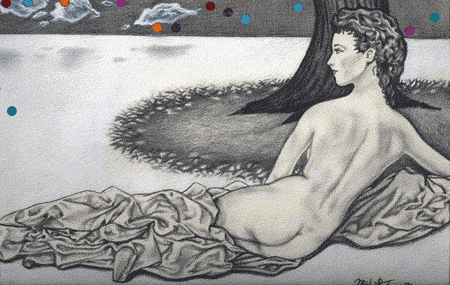
Muzak Nude study (1983)
A mixed media drawing on paper.
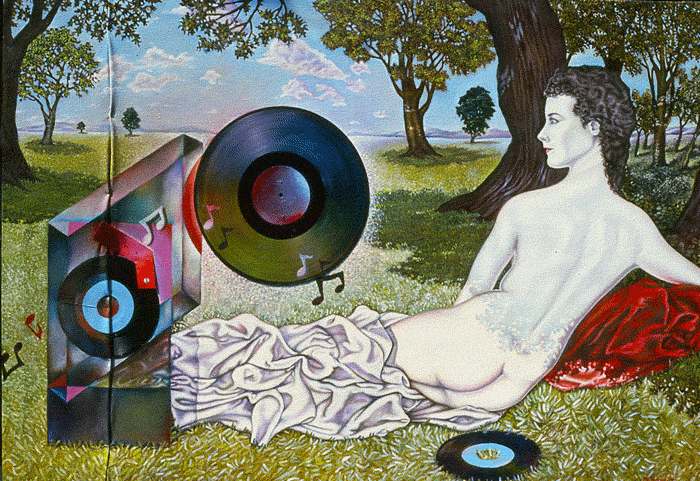
Muzak Nude (1983)
Cloth sculpture and modified found object are employed in a figurative setting (developed in the previous drawing). Oil and acrylic paint are the primary media.
Snares of Anatomy: Because I did not have access to live models during my undergraduate studio work, I had to envision female anatomy and retrofit it imperfectly from catalog and magazine photos. It was doubly difficult to perdict lighting effects and the geometry of drapery folds over these volumetric forms. In lacking expertise in these interpretations, I wisely withdrew from ambitious figure painting on entering graduate school.
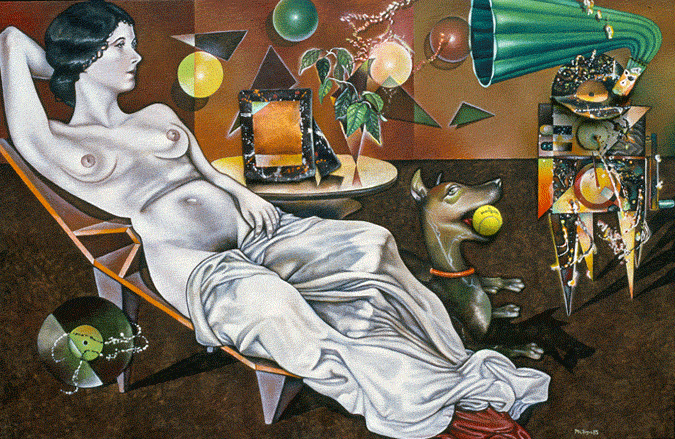
The Other Worldly Nude (1984)
The materials used here were identical to Muzak Nude.
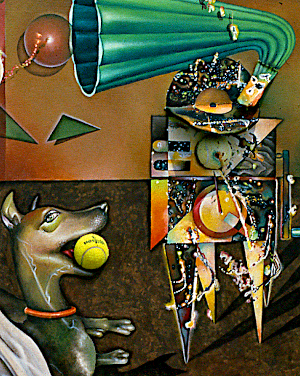
The Other Worldly Nude (detail)
With paintings from this period, I was either cutting through the canvas or sewing things into it. The LP record on the drip-paint Victrola was fashioned from cloth sculpture. Playing off Cubism, it comes out toward the viewer at a right angle. The tennis ball in the dog’s mouth is an actual tennis ball.
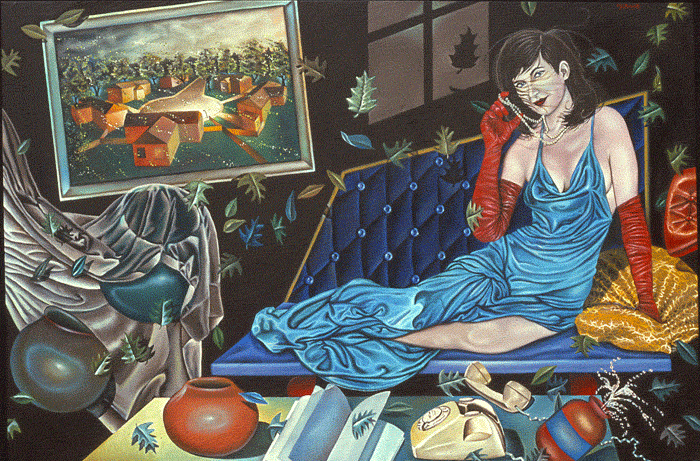
Whispers, Isabella? (1984)
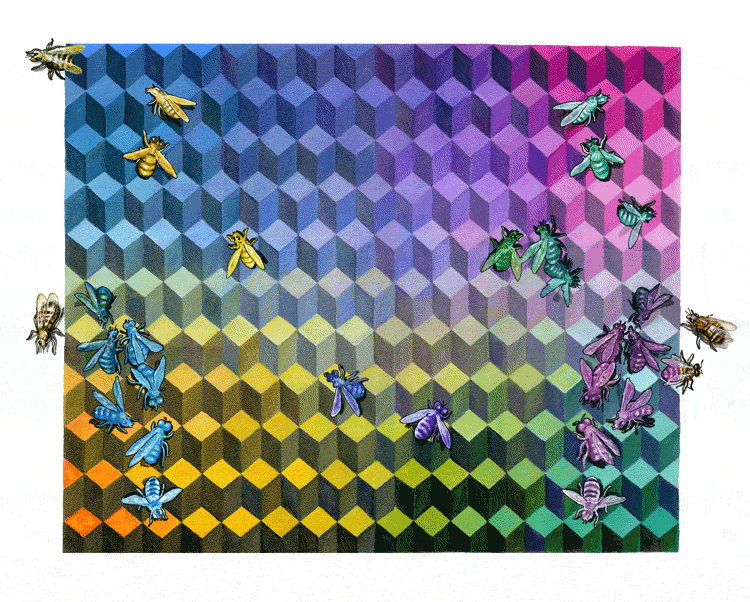
Nature confusing Optical Art for Nature (1983)
This is a parody on Victor Vasarely’s claim that Optical Art (Op Art) was nature painting. Colors are here paired by color theory, reflecting information gained from my color theory classes. This work is acrylic on heavy Arches paper from 1983.
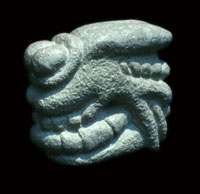
Mayan Fly Devouring Fly (1984)
This is a soapstone craving from a sculpture class.
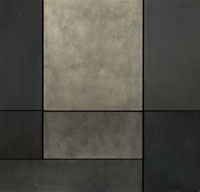
Untitled (1984)
Executed with pencil and powdered graphite on illustration board. This class exercise evoked the gridwork of Piet Mondrian.
Destruction of Some Works: Young artists tend to create large ambitious pieces. These works become headaches where photographing, shipping, and storage is concerned. In my case (and I do not think I am unusual for doing this), early works were destroyed where they could not be properly stored. Moreover, I came to regard these pieces as eyesores when compared to later, better work. Many paintings were destroyed in Memphis after graduate school because of their three-dimensional elements. This aspect made them bulky once they were removed from their stretchers, so they did not return with me to Bloomington, Indiana in late 1988.
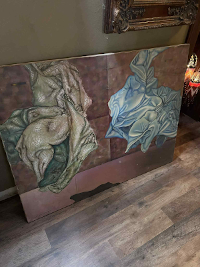 Imploding Kleenex as rediscovered in 2025.
More Unfinished Business: In 2025, my sister informed me that she had given fourteen of my early paintings to her best friend without my knowledge. I believed all these canvases (including Imploding Kleenex) were destroyed in the summer of 1988. The friend had no more use for them and so returned them to my sister.
Over Christmas that same year of 2025, a morning was spent with a utility knife and hammer atomizing these works before putting their remains in a dumpster. The works had not been stored properly in the intervening decades. Heat and grime had ruin most of them, but they would have been destroyed anyway because I do not have the space—or desire—to keep inferior work in my current apartment.
×
![]()
×
![]()
Next/ Back/ Artworks Portal Page
Copyright © 2016 michael l. teague all rights reserved.