Index:
1) Introduction
2) Art Criticism
3) Intrusive Thinking and Creativity
4) The Role of Missing Information in Creativity
5) Art and Obsolescence
6) Art, A.I., and Culture
7) Autism and The World
8) YouTube Channel
9) Miscellaneous
Art versus its Admirers: The arts divide naturally between creators and community. Most artists, being socially lacking, aspire to a monk-like existence—or at least default to a reliable sanctuary when they want to define themselves in opposition to everything else. The community, by contrast, is attracted to the idea of the creator, although members therein may have little genuine interest in the creator’s welfare. Let us not forget that the community of art exists principally to be a community. It is social, so intends, by its meetings and get-togethers, to plan other events that look suspiciously like more meetings and get-togethers. The community loves its own company, especially in settings where art serves as a backdrop, or as something to be discussed in lectures where the attendees can be seen attending.
Personal Reality versus Photorealism: We are living in a golden age of photorealism. However, many current proficients are not as candid about their sources as those who initiated the approach in the 60s, 70s, and 80s. I dabbled in photorealism in my earliest studio painting classes in 1983. A few images of this type are seen on my first Portfolio page. This technique still occupies a small corner of my toolkit, but I prefer working from real-life and imaginary objects.
Both binocular vision and the imagination force one to blend (interpret) perspectives. A camera is monocular and flattens everything by definition, making the photo-reductive taint hard to cast off. Worse still, the more the painting adheres to the photograph, the more the painting will be confused for a photograph.
I taught photorealist technique to students over the years. None were so gifted at it that this fidelity problem arose—and their paintings were better for it! Indeed, it was rare when the final product was not better than the photograph that inspired the painting.
When I use photo sources in a painting, they tend to be static and/or collage-like. The latter quality, as I have discussed previously, can be integral of my work, as it introduces a cerebral, abstract feature to a composition. However, if the photo element is too dominate, it bites into the options available for how to resolve the flow of the painting around it. Some artists are more likely to lean into the photorealism, but that is never a desirable outcome for me.
Surrealism versus Pop Surrealism: At the time of my exhibition at La Luz de Jesus Gallery in 2002 in Los Angeles, Pop Surrealism bore minor comparison to figurative Surrealism as it was originally conceived in 1920s Europe, yet with the addition of a popular culture overlay circa Mid-Century United States, mostly originating from California. My 2002 exhibition felt like a homecoming due to so many kindred spirits converging on a moment in history. Most artists had cultivated a unique style within their own hot house, and it was an exciting time.
Since then the term ‘Pop Surrealism’ has come to be defined more peripherally and less integrally to what has evolved in actuality. It may now serve primarily as a descriptor for whimsical and decorative flourishes. Where imagination is the engine and not photography, the art may be less imaginative than one has right to expect. Here the art may evoke nostalgic children’s book illustration, with soft pastel nursery room colors and playroom clutter.
My characterization may be dated as of 2026, since this is where I left the movement some years ago when last I checked: Low-brow pioneer and painter of big-eyed children, Mark Ryden, was still the leading light. It may be the case that even his layers of parody and symbolism have been removed by now. The art movement felt like (to me) that it wanted to evolve away from rough edges. That leaves straight commercial illustration as a final option.
Various subcultures have been absorbed, including skateboard, graffiti, and tattoo cultures. The line between commercial enterprise and fine arts’ inspired uselessness is not so well maintained as it used to be, as everything begins to look like an undisguised hustle.
Many artists in Pop Surrealism may be seeking to enshrine the culture they passionately consumed while coming of age. Though this development is understandable, these creatives perhaps preserve their past with too much fidelity, which blurs the line unproductively between transformation and arrested adolescence.
When I look at the likes of a Charles Burns or a Robert Williams, I see gifted artists who were able to see past the crappy Saturday morning cartoons they were fed as children. Yet somewhere along the line, this impulse to reject accepted culture disappeared. Blame for this may be assigned the Disney-fication of culture, which so successfully learned to exploit and direct the appetites of children that, by the turn of the millennium, little room was left for the insertion of personal imagination. Pop culture became big business, and many talented artists populated these fields to create work of unheralded professionalism. If artists are less bothered by their wholesale reproduction of this culture nowadays—because they cannot think past its achievement—then this also may be the reason why they are less self aware.
At the very least, there is a strong graphic arts orientation to Pop Surrealism. Graphic design is a durable adhesive in any art form where it is introduced. These descriptors are stylistic; and if there is any dimension within them that may be described as original to the artist, then these become less obvious as more artists embrace the style and imitate it.
Art movements have their pioneers; but they soon run out of pioneers. Next come the imitators and the improvers on the style: i.e., second and third generation iterations of the original ideas, only without the self-awareness that this is the exact business in which one is engaged. From there, it is a race to the bottom, although nobody will recognize it as such until a new maverick comes along and points this out. A new group of young turks form around this rejection of the existing order.
Rinse, lather, and repeat…
Los Angeles, Low Brow, and Me: I first visited LA in 1998 for a college art convention, where I interviewed for teaching positions in the Midwest. As luck would have it, I spent mornings hanging out in a Santa Monica coffeehouse while my friend pursued work at his law office down on Wilshire. This coffeehouse sat near The Rico Gallery, where a work of mine had shown in a group exhibition a few months prior. Gradually I drifted over there and introduced myself, and tried to make the most of my nonexistent West Coast connection.
That gallery was not unlike other galleries personally known to me over the years, including the Chicago gallery that represented my work in the 1990s. An unnameable dread accompanied me when I stumbled into the The Rico Gallery on that bright, sunny afternoon. Nowadays, I would name that feeling as too little foot traffic syndrome. Few galleries thrive as businesses, and most last no more than a few years. (The Covid Lockdown may have killed off small business art galleries once and for all.)
I returned to LA in June of 2002 for a two-man show at La Luz de Jesus Gallery. Those paintings may be viewed on my third gallery page. I wanted desperately to move to LA in order to cement my relationship with the emerging Low Brow, Pop Surrealist arts community, but, as I explain on the same gallery page, this was not going to happen for me with Aspergers. Regardless, Los Angeles held a romantic allure for many years, with a lot of what ifs…
Romanticism aside, LA went downhill slightly from my first visit to the second. In the intervening decades, this decline has accelerated. I imagine life for artists in the city has not changed significantly, although, as the Low Brow movement has morphed over time, I doubt its founders find as warm a welcome now as they did then.
An independent film made around 2010 featured Low Brow artists known to me from 2002, but I suspect that some of these artists have not flourished in the intervening years.
The Surreality of My Pop-Surrealist LA Show: I mention, in passing, my reaction to my 2002 LA show somewhere among my YouTube videos, in how I felt like a stranger rather than the guest of honor. I was available for conversation, but few took the opportunity; and of those who spoke to me, few wished to talk about the art on the walls. Nevertheless, someone told me that my show was one of the best they had seen at the gallery.
How do I evaluate my success at this show, apart from selling a few pictures? And mostly to someone who had collected my work before?
The more you delve into the economics of the art world, the more you encounter one or two collectors who make all the difference in an artist’s life. As for everyone else who attended my opening, a show at La Luz de Jesus in 2002 was more about being seen than riding the wave of a brand new art movement in the making.
To the degree I might call my show a failure, it may be due to a life-long problem I have: arriving too early on the scene, before the important collectors assemble.

Juxtapoz Magazine and The Loss of Vital Moments: As one ages, one purges. I subscribed to Juxtapoz Magazine for several years beginning in the late 1990s. Long before my romanticism for LA waned, this subscription was ended because I sensed Low Brow was running out of steam.
As the market solidified, ads (often the same ones repeated from issue to issue) became more prominent in the magazine. The same cast of artists were appearing too frequently in the feature pages. Moreover, newer artists began to look like leftovers from Postmodern New York galleries.
This rebranding did not fool me, although developments of this sort are understandable given art magazines need to pay their bills and grow their businesses. Unfortunately, this strategy, when compared to the typical lifespan of an art movement, follows the same projected path. My idealism at the time of my LA show made me blind to what is painfully clear to see now.
Candidly, a smidgen of resentment also shaped my souring opinion of Juxtapoz after 2002. I had been promised a spread in the magazine that never materialized. The value of presenting high quality original oil paintings at La Luz de Jesus Gallery should have been a no-brainer. This lost opportunity may have come down to me not having quality digital images of my paintings.
A digital camera was not on my radar at the time of my 2002 show. Still, time stamps from my first digital camera start showing up in my portofolio folder by that year’s end. This camera (discussed in my notes concerning my cameras on my third gallery page) possessed a low megapixel count, so it would not have produced quality prints much larger than a postcard. This may have been too small for a full-page magazine spread.
These regrets signify little since La Luz de Jesus Gallery professionally photographed my paintings at the time of the exhibition. An analog camera was used, given that they graciously mailed me large format slides for my records, post-exhibition. These images provide the best reproductions for my sold paintings from that era.
This courtesy notwithstanding, Low Brow was very much a game of inside baseball, and perhaps this explains why Juxtapoz Magazine’s showed little interest in fresh perspectives from outside Los Angeles.
Hi Fructose Magazine began publication to counteract this counter-culture drift towards conformity. But it too became a victim of diminishing returns, which required commercialism to save it: As Pop-Surrealism began to splinter into various niche styles, Hi Fructose has become better known for its merch of established artists than for discovery of new original talent. (They never responded to my submission in 2022!)
In hindsight, the exhibition opportunity I received from La Luz de Jesus Gallery may have come down to me having a subscription to Juxtapoz Magazine at the time, given the symbiosis between the two organizations. Not having a subscription to Hi Fructose Magazine may be the reason why they never responded to my submission. It may come down to something as simple (and shortsighted) as that, where it is more about the clubhouse than the mission statment.
Apart from glimmers of mercurial imagination here and there, much of the art I recently revisited in the pages of Juxtapoz has not aged well. Much of it comes off as amateurish and calculated. Many artists were rushing into this new market. Pop culture imagery was hastily incorporated into new work with little reflection or maturation. This rough and ready quality, though lacking the virtue of time-honed craftsmanship, nevertheless matched Low Brow’s natural disposable culture aesthetic, so it was what it was.
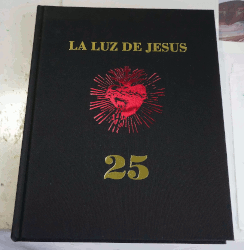
A painting of mine (which I later reworked) was reproduced in a book that commemorated La Luz de Jesus Gallery’s Twentieth Anniversary in 2011. The artwork for this show and publication was notably better than where I left the movement in the pages of Juxtapoz in 2003.
Evolution to Extinction: La Luz de Jesus Gallery cannot be spared criticism in how it has evolved over the years. Its website presently describes its submission criteria as “figurative, narrative, and lowbrow.” Each of these descriptors is like an unintended straight jacket, where the art to be considered becomes narrower by definition. What is left looks like the curated aesthetic of a vintage store version of Pier One Imports.
First, “figurative art” is just Opposite Land of Abstract Expressionism. There is no virtue in rejecting one blanket approach for the other, apart from the vice of filtering out useful hybrids. The strange art aesthetic La Luz professes to embrace begins to look curiously less strange. When viewed collectively, the body of work on their site may be described as strained, anemic, or sterile because it struggles to stay cleanly within the boundaries set for it.
This, however, may be an unfair characterization on my part. It may be that the gallery merely represents the calibre of talent presently available to it. Artists tend to pool at the bottom as art movements age.
I am reminded of Art Forum Magazine of the late 1980s. It was filled with pages of copious text describing contemporary art. Few (if any) images were paired to its feature articles. This omisson was excusable. Modern art of this time was uniformly terrible. But for its different focus, current Lowbrow shares an similar crisis of identity.
Respectable art—and this is what La Luz now promotes—veers dangerously into ethereal-ness. The art does not jar or excite, but instead evaporates on your tongue like a dry, over-priced wine. It is decorative yet non-intrusive. It blends surprisingly well with shabby chic apartment décor.
Next comes the “narrative” descriptor of La Luz’s house style, which, for me, is even more offensive than the term “figurative.” Great art appeals to the non-verbal senses and not to the journalistic left brain. Tell a story if you must, but give the viewer the option of ignoring your story—as most will do if the picture, on its own merits, seduces them.
It may be that these criticisms miss the central problem of every age, which is that no one intends to become mediocre. You just end up there, anyway.
Copyright © 2023-2024 michael l. teague all rights reserved.