Index:
1) Introduction
2) Art Criticism
3) Intrusive Thinking and Creativity
4) The Role of Missing Information in Creativity
5) Art and Obsolescence
6) Art, A.I., and Culture
7) Autism and The World
8) YouTube Channel
9) Miscellaneous
Alternative Comics and Me: Comics are so far back in my rearview mirror that it is difficult for me to write about them. That history predates this website, and the pages in my Comics Portal that reflect on this time do so sparingly.
I have earned my primary income from teaching art at a community college, exclusively on the non-credit side where older students are generally more appreciative of instruction. This income, as minimal as it is, and where combined with the security of social safety nets, has allowed me to live independently as an autistic adult. Consequently, I have experienced little pressure to conform as an artist in any sense—not that I would have known how to pull that off.
I have had more success as a cartoonist than I ever had as a painter, largely because comics do not require the artist to live in the city where the comics are published. Regardless, a series of bad decisions, especially regarding the inferior publication method of my Xeric Award comic book, Epic Dermis n1, with a local printer in the late 1990s, contributed to a cascade of failures.
It did not help that I was a square peg sizing up round holes. My unique blend of drawing and storytelling was to combine the goofy with the grotesque. Throw in a heavy dash of sexual innuendo and New Yorker comic sophistication, and you have something that was nearly impossible to describe—and completely impossible to market! In retrospect, my concoction of improbable influences carried over, with little alteration, into my painting—and with the same unsuccessful outcome.
Some within the alternative comics community were accepting of my wide net, while purists were less so. There are many different ways you can go with alternative comics, and none of them are prosperous, so arguments about purity and approach can be safely dismissed as navel-gazing.
Cartoonist versus Comic Book Creator: My fatalism may be justified by the number of alternative comics that I admire. It is a short list. I am not drawn to memoirs or journals about one’s life or feelings. Comics artists are especially self-absorbed in this regard, and though their garden variety feelings of inferiority and neurosis may attract readers who are similarly afflicted, feelings rarely rise to the level of insight, or humor. Most comics artists are not Franz Kafka.*
As for humor, funny is not really a thing in alternative comics. I suspected that some in this community counted my sense of humor as a character flaw. A boundary is drawn between comic book artists and cartoonists around the subject of humor. Gags and wordplay are dismissed as children of a lesser god, and one’s attraction to humor is assumed to be of an unoriginal or sophomoric nature.
This reaction is understandable since drawing ability is easier to come by than a geniune sense of humor. Unfortunately, wit often gets written off in a way that portrays the hasty critic as being unappreciative of talents that he neither possesses nor values.
I am a natural contrarian. Sacred cows were a frequent target for my comics until I ceased making them, although my jabs were so obtuse at times that the offended were never quite sure if I had openly offended them. I was neither a journalist nor a pomelic as a humorist, so preferred coming at my subjects from oblique angles that kept people guessing.
By the end of my production of the Blender Kitty comic strip in 2010, I had already transitioned into being a novelist. And by the endpoint of my Profiles in Confusion comics in 2015, I was no longer interested in being funny. Writing a novel was a better form of world building for my creative energies at this time, yet here too I was sizing up a pockmarked landscape of round holes.
(*) My YouTube Channel about autism and the arts would have more followers if I made more videos about my trials and tribulation as an artist with autism. But such complaining would make me nothing special, and that is the point: YouTube is yet another version of confessional comics.
Background in Music: I was raised in Memphis, Tennessee circa 1960s, when it was a hotbed for much popular music. My father had been a guitarist in a rockabilly band when he was younger in Arkansas during the 1950s, and though I learned to play the guitar (and piano) as a teenager, I was not attracted to roots music, per se.
I only started actively listening to rock music on our FM rock radio station, as well as our alternative college radio station, around 1971. I had a front row seat for all the great albums of the early 1970s—especially British rock: for which Memphis audiences had a strong appetite. By the mid-1970s, things were beginning to wind down creatively in rock music. A local record store I frequented starting budgeting more space for classical music LPs. This was around the time I began majoring in music at college and studying classical music. I liked all kinds of rock music as a teenager, but was particularly attracted to progressive rock, or classical rock as it was then called. Classical music was a natural fit for me.
I was a music composition major until 1980, but gave it up after transferring to the art program at Memphis State University. When I returned to music composition in 2008, it was to blend my many musical tastes into a hybrid style.
The Dilemmas of Mixing Music: Most of my first and second year Garageband musical creations were written in as little as seven to ten days, whereas mixing these compositions in Logic Pro X has been over a decade in the making. Of all my artistic undertakings, none have been more frustrating or difficult than mixing music. Like most things, I fell into learning it backwards.
The piano is my favorite instrument, yet because it is both acoustic and percussive, it is a nightmare to mix in a loud ensemble. At its rumbly low end, it is a filing cabinet hurled down a cinderblock stairwell. At its high end, it is comparable to birds flying into plate glass windows. Where its role is supportive, it can be pushed to the back of the room with confidence. With some instances of my music, however, it is the driver of a busy composition, and consequently possesses an involved construction that requires visibility.
I have developed a number of A/B testing methods for evaluating my mixes, but ultimately it has been my exposure to classical music recording that has shaped my ear. The recordings I own on CD, which predate The Loudness War and the need to compress every recording to maximum volume, are my favorites. When I look at the waveforms for these recordings, the volume is low and the waveform flows like an expansive and pleasing western landscape.
While learning the craft of mixing, I watched many video tutorials—all of which were for rock music and maximized volume. On the whole, this instruction was less than useful. Given the assortment of electronic and acoustic software instruments I employed in a given composition, some work well with compression while other did not. Over time, the volume averages down in my projects despite every attempt to raise it. Woodwinds, particularly, are like air-powered nail guns fired at the eardrum when they are closely mic-ed, or—heaven forbid—when they are compressed. Where two or more instruments dulpicate a melodic line, this sound can be shaped tonally by altering how loud one instrument is relative to another. The color changes as volume relationship changes. Symphonic recording push all instruments into a deep space where acoustical reverb can sort them out. Increasingly, as I continue to revisit and finetune my compositions, I am lowering the volume.
Near-Death Experiences: Being an avid walker means I spend more time as a pedestrian than I do driving behind the wheel of a car. Statistic bear out, regrettably, that pedestrians are more likely than drivers to be injured or killed in the wild. Four near-death experiences mark my history as a pedestrian: three while taking my daily exercise on the streets of Bloomington, IN. These incidences have occurred, on average, about once every ten years.
1) The first occasion happened one late evening in April (around 1996) while I was walking home from the coffeehouse. A car was driving the wrong way down a one-way street. It pulled into an alley and cut me off on the sidewalk. A teenager pulled a gun on me from the passenger window, and robbed me of my wallet before speeding away.
2) The second occasion happened at a dangerous intersection near Indiana University’s Campus in the early 2000s. A car was caught in cross traffic in late afternoon. A second car struck it and sent it whirling around onto the sidewalk. Its fender clipped my shin, and perhaps would have killed me had I not jumped out of the way. This occurred during the writing of my first novel, which already included a near fatal traffic accident for the protagonist.
3) The third incident did not occur in Bloomington but at The Grand Canyon in 2014. Calling it a ‘a near death experience’ is an interpretation, but here is my memory of it: My then-girlfriend and I had already gone through the park, and were driving east and southbound back toward Flagstaff and Phoenix. This portion of the road hugged The Colorado Gorge. I was so impressed with this unheralded attraction that we pulled off the road next to a Native American kiosk so I could take a picture of it. I dashed down this dirt path toward the imposing view, even given my profound fear of heights. Nearing the vicinity, I heard footsteps rapidly approaching from my rear. I slowed with foreboding, took one quick picture before running back the way I came. I passed a hooded individual who was gaining on me. Had it been his intention to hurl me down the gorge while I stood inattentively snapping pictures, his plan was foiled. Had he tried to wrestle me back toward the ledge at that point, we would have been in sight of the Native Americans at the kiosk.
In my present novel, I write about a character who takes a roadtrip with Death through Arizona.
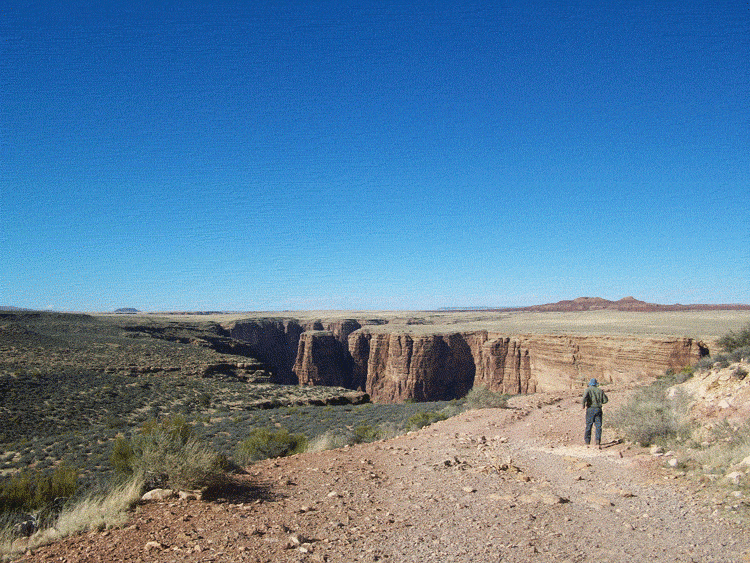 I took a second picture at the gorge, which I did not remember at the time. The hooded man who had me in fear for my life can be seen on the left. Where was he going in a hurry in so desolate a location? I guess he had to keep up the pretense that he was going somewhere.
4) My last near death occasion was the most frightening. It occurred in June of 2020. I was walking near Rosehill Cemetery when a freight truck slowly passed me; the driver appeared lost. He turned into a lot behind me along the narrow street. The top of his truck caught on low hanging power lines. With lightning speed, the vehicle, without realizing it, pulled down a row of power poles (at least six of them!). I heard loud popping behind me, and by the time I realized what was happening, the poles were coming down like trees in a tornado. An explosion of plasmic electricity erupted over my head—and gushed like water from a garden hose! I fled in the opposite direction of the falling poles, and sheltered against the brick retaining wall that bordered the south side of the cemetery.
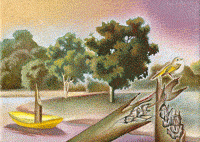 This landscape painting, titled Felled, commemorates this traumatic event. The full image may be viewed on my Current Landscape gallery page.
This last incident recalls the death of a character, also from my first novel. He is morbidly afraid of electricity and dies from an encounter with ball lightning. There are plenty examples like this in my writing: In the prologue of my current novel, a character suffers from an unspecified eye affliction. Meanwhile, I develop Fuchs Corneal Dystrophy a few years later. I incorporated Fuchs into later chapters of the story.
The Power of Coincidence: Many of the coincidences that occurred between plot elements of my first novel and my personal life were never set down in writing. This pattern of fiction predicting real life has continued, as far as I have communicated, into my new book.
Many strange events happened around the time of my mother’s passing in 2013, and since the new book indirectly deals with this chapter in my life, I have tried to accommodate the most striking coincidences in its pages. The most recent event cannot be explored fictionally, so I set it down here:
During the Christmas of 2022, on Christmas morning, my sister shared a video with me, which was a five second snippet from our mother’s last Christmas on Earth. Hearing my mother’s long-removed voice filled me with sadness, and it was not until later, after returning home to Bloomington, that what she said in those five second pierced me.
She was looking over a book of murder mystery fiction, which she received as a present. (My mother loved reading.) Though weak of voice, she says to my sister filming her, words to the effect, that “he has started (or introduced) a new character…” This was all she said. She was referring to the author of her book, of course, in what must have been the latest installment in a series of books by him.
The strangeness in this utterance is this. The mysterious events surrounding my mother’s passing were so compelling that I needed to include them in my novel. This required creating a new character to which these events could be assigned, and then creating a special section in the middle of my book where this character could relate these events. This character appears in no other part of my book. This interlude was conceived and written after my mother passed in early September, ten months after she spoke in that video. Although I had been present at her last Christmas, I did not know of this video’s existence, or my mother saying these words.
(I have since incorporated this meta feature into my book.)
Copyright © 2023-2022 michael l. teague all rights reserved.